Document Type : Original Article
Authors
1
Department of Accounting, UAE.C., Islamic Azad University, Dubai،United Arab Emirates
2
Department of Accounting, SR.C, Islamic Azad university, Tehran, Iran
3
Department of Accounting, Dam.C., Islamic Azad University, Damavand, Tehran, Iran
4
Department of Accounting, Qo.C., Islamic Azad University, Qom, Iran
Abstract
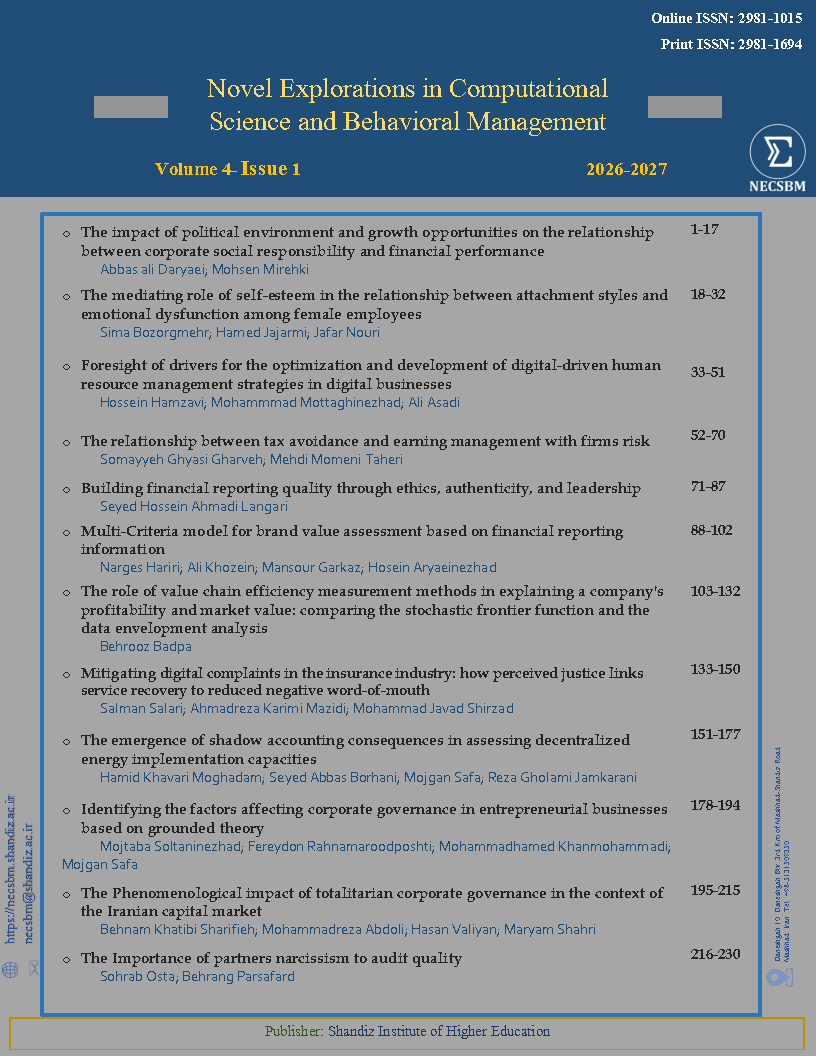
Corporate governance has become one of the key strategic issues in contemporary management over the past two decades, such that the quality of corporate governance determines the level of transparency, accountability, and organizational integrity. In entrepreneurial businesses, the importance of this issue is even greater than in large and mature firms, because startups and nascent ventures operate under high uncertainty, limited resources, flexible structures, and environmental risks. The methodology of this study is mixed qualitative-quantitative; in the qualitative phase, grounded theory was employed, and in the quantitative phase, the FDAHP technique was used. To identify the components, interviews were conducted with 14 experts, and open, axial, and selective coding were applied. The qualitative findings led to the identification of 61 effective components, and after three rounds of fuzzy Delphi analysis with a grounded theory approach, 28 influential components affecting the corporate governance process in entrepreneurial businesses were identified, including ownership structure, transparent financial reporting, strategic planning, dispute-resolution mechanisms among stakeholders, ensuring financial sustainability, financial and ownership transparency, preventive and supportive actions, technological factors, effective communication, board meetings, and others.
Keywords
Subjects