Novel Explorations in Computational Science and Behavioral Management

Novel Explorations in Computational Science and Behavioral Management

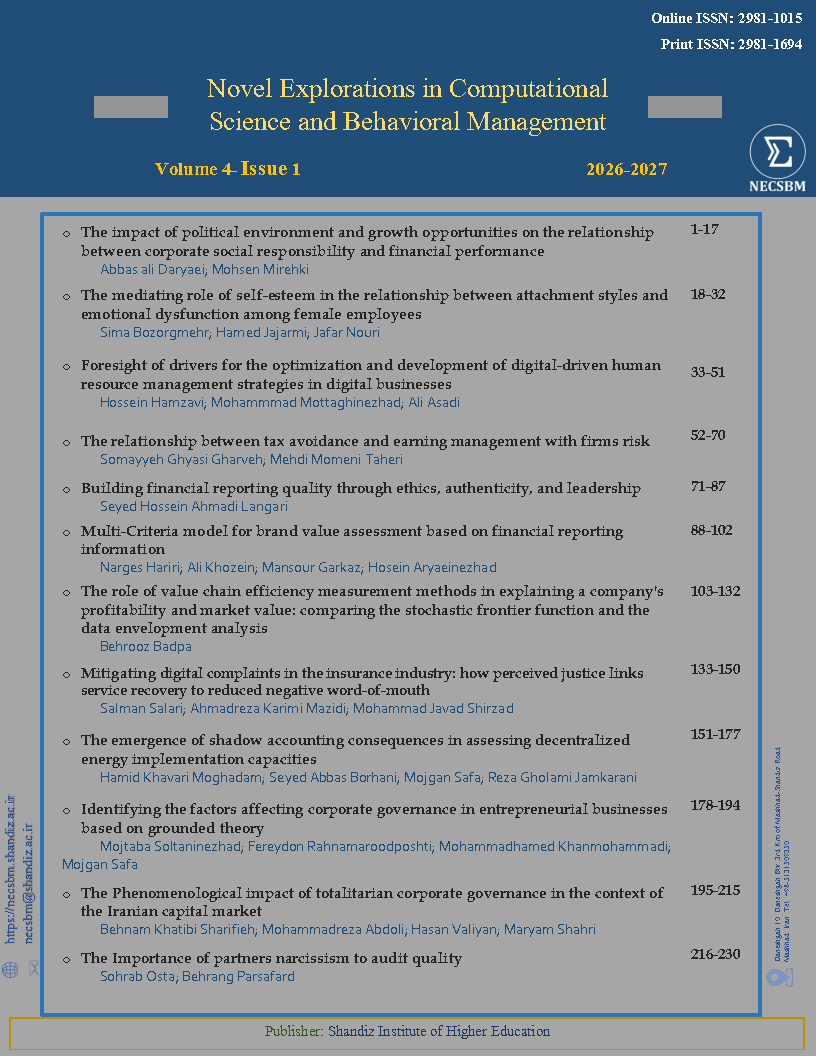
Identifying the factors affecting corporate governance in entrepreneurial businesses based on grounded theory

Document Type : Original Article

Authors
1 Department of Accounting, UAE.C., Islamic Azad University, Dubai،United Arab Emirates
2 Department of Accounting, SR.C, Islamic Azad university, Tehran, Iran
3 Department of Accounting, Dam.C., Islamic Azad University, Damavand, Tehran, Iran
4 Department of Accounting, Qo.C., Islamic Azad University, Qom, Iran
Abstract
Corporate governance has become one of the key strategic issues in contemporary management over the past two decades, such that the quality of corporate governance determines the level of transparency, accountability, and organizational integrity. In entrepreneurial businesses, the importance of this issue is even greater than in large and mature firms, because startups and nascent ventures operate under high uncertainty, limited resources, flexible structures, and environmental risks. The methodology of this study is mixed qualitative-quantitative; in the qualitative phase, grounded theory was employed, and in the quantitative phase, the FDAHP technique was used. To identify the components, interviews were conducted with 14 experts, and open, axial, and selective coding were applied. The qualitative findings led to the identification of 61 effective components, and after three rounds of fuzzy Delphi analysis with a grounded theory approach, 28 influential components affecting the corporate governance process in entrepreneurial businesses were identified, including ownership structure, transparent financial reporting, strategic planning, dispute-resolution mechanisms among stakeholders, ensuring financial sustainability, financial and ownership transparency, preventive and supportive actions, technological factors, effective communication, board meetings, and others.
Keywords
Subjects

عسگرپور، رسول و ابوطالبی، حمید. (1403). تأثیر حاکمیت شرکتی بر عملکرد مالی شرکت‌ها ازطریق متغیر واسطه‌ای شفافیت با استفاده از روش فراتحلیل. مدیریت دارایی و تأمین مالی، 12(1)، شماره پیاپی (44)، 111- 124. https://doi.org/10.22108/amf.2024.139769.1837
ترابی، محمد حسن، سخدری، کمال، عزیزی، محمد، موسی خانی، مرتضی. (1401). ارائه مدل کارآفرینی سازمانی درکسب و کارهای درون سازمانی مبتنی بر حاکمیت شرکتی در ایران، فصلنامه مدیریت توسعه و تحول، 14(49)، 11-20.  https://sanad.iau.ir/Journal/jdem/Article/949143
فروزانفر، هومن؛ موسی خانی، مرتضی؛ الوانی، سید مهدی؛ کاظمی، ابوالفضل. (1402). ارائه مدل کارآفرینی سازمانی مبتنی بر حاکمیت شرکتی در صنعت بانکداری، فصلنامه مدیریت توسعه و تحول، 15(53)، 1-13.  https://sanad.iau.ir/Journal/jdem/Article/949541
باقری، محمود، صادقیان ندوشن، مهرداد. (1395). تئوری ذینفعان در حقوق شرکت‌ها، فصلنامه قضاوت، 87، 27-54. https://www.ghazavat.org/article_162151.html
تفرشی، محمدعیسایی، یحیی­پور،جمشید. (1392). تئوری ذینفعان بارویکردمقررات شرکت­های سهامی ایران، فصلنامه بورس اوراق بهادار، 23(6)، 139-167. https://www.ensani.ir/file/download/article/20140722134655-9455-99.pdf
حساس یگانه، یحیی. برزگر، قدرت‌الله. (1391). مسئولیت اجتماعی شرکتها، سیر تکامل مفاهیم وتعاریف، فصلنامه حسابدار رسمی، 17. https://www.iacpa.ir/portals/0/pdf/faslnameh/faslnameh21/MasooliateEjtemaee-HassasYeganeh&Barzegar.pdf
داوری، ابوالفضل، داوری، هدی. (1400). تأثیر سرمایه فکری بر عملکرد مالی بانک مسکن از طریق نقش حاکمیت شرکتی، رویکردهای پژوهشی نوین در مدیریت و حسابداری 5(17)، 36-48.  https://majournal.ir/index.php/ma/article/view/827
شریفی فرد، محسن، کعب عمیر، احمد، محمودی، علی و مهربانی، فاطمه. (1401). ارائه الگوی هژمونیک ایجاد تعارض منافع ذینفعان در شرکت هایی با مالکیت خانوادگی: ویژگی های نظریه کادیلوئیسم ها در حاکمیت شرکتی. حسابداری مدیریت، 15(55)، 112-133.  https://www.magiran.com/p2567566
ضیاء، بابک، و کفائی، فرزاد. (1399). طراحی مدل جامع حاکمیت شرکتی با رویکرد نوآوری باز در صنعت بیمه. مدیریت نوآوری در سازمان‌های دفاعی، (پیاپی 9)، 25-50.  https://search.isc.ac/dl/search/defaultta.aspx?DTC=8&DC=1190867
فریورتنها، الهه و احمدی جوهرانی، محمدرضا. (1403). بررسی نقش حاکمیت شرکتی و تاثیر آن بر عملکرد شرکت های پیمانکاری، دوازدهمین کنفرانس بین المللی چشم اندازهای نوین در مدیریت، حسابداری و کارآفرینی، تهران.
موسویان، سیدحسین. (1395). بررسی تاثیر خصوصی سازی بر عملکرد مالی شرکتهای پذیرفته شده در بورس اوراق بهادار تهران، چهارمین کنفرانس بین‌المللی پژوهش‌های نوین در مدیریت، اقتصاد و حسابداری، برلین-آلمان.
نظام پور، عشرت و محمدی، احمد. (1401). مطالعه ادبیات نظری اهمیت حاکمیت شرکتی و عملکرد در پژوهش های حسابداری. نشریه علمی رویکردهای پژوهشی نوین مدیریت و حسابداری، 6(23)، 1277-1283. https://majournal.ir/index.php/ma/article/view/1787
Armstrong, C. S., Blouin, J. L., Jagolinzer, A. D., & Larcker, D. F. (2015). Corporate governance, incentives, and tax avoidance. Journal of Accounting and Economics, 60(1), 1–17. https://doi.org/10.1016/j.jacceco.2015.02.003
Armstrong, C. S., Guay, W. R., & Weber, J. P. (2010). The role of information and financial reporting in corporate governance and debt contracting. Journal of Accounting and Economics, 50(2-3), 179–234. https://doi.org/10.1016/j.jacceco.2010.10.001
Baqeri, S., et al. (2015). Stakeholder theory and corporate responsibilities. https://www.ghazavat.org/article_162151.html
Brickley, J. A., & Zimmerman, J. L. (2010). Corporate governance myths: Comments on Armstrong, Guay, and Weber (Simon School Working Paper No. FR 10-29). SSRN. https://doi.org/10.2139/ssrn.1681030
Bruton, G., Ahlstrom, D., & Puky, T. (2021). Corporate governance in entrepreneurial ventures. Entrepreneurship Theory & Practice. 10(1-2), 1-157. http://dx.doi.org/10.1561/0300000037
Claessens, S., & Yurtoglu, B. B. (2013). Corporate governance in emerging markets: A survey. Emerging Markets Review, 15, 1–33. https://doi.org/10.1016/j.ememar.2012.03.002
Davis, G. F., & Marquis, C. (2004). The globalization of stock markets and convergence in corporate governance. In V. Nee & R. Swedberg (Eds.), Economic sociology of capitalism. Princeton University Press. https://www.hbs.edu/faculty/Pages/item.aspx?num=19785
Dyck, I.J. Alexander and Zingales, Luigi, (2002).  The Corporate Governance Role of the Media, NBER Working Paper No. w9309, Available at SSRN: https://ssrn.com/abstract=347081
Eisenhardt, K. M., & Graebner, M. E. (2007). Theory building from cases: Opportunities and challenges. The Academy of Management Journal, 50(1), 25–32. http://www.jstor.org/stable/20159839
Freeman, R. E., Harrison, J. S., & Zyglidopoulos, S. (2018). Stakeholder theory: Concepts and strategies. Cambridge University Press. https://doi.org/10.1017/9781108539500
Harrison, J. S., & Wicks, A. C. (2021). Harmful stakeholder strategies. Journal of Business Ethics, 169(3), 405–419. https://doi.org/10.1007/s10551-019-04310-9
Harrison, J. S., Freeman, R. E., & Sá de Abreu, M. C. (2015). Stakeholder theory as an ethical approach to effective management: Applying the theory to multiple contexts. Revista Brasileira de Gestão de Negócios, 17(55), 858–869. https://doi.org/10.7819/rbgn.v17i55.2647
Hassas Yeganeh, Yahya, & Brzgar, Ghodratollah. (2012). Corporate social responsibility: Evolution of concepts and definitions. Official Accountant Quarterly, 17. https://www.iacpa.ir/portals/0/pdf/faslnameh/faslnameh21/MasooliateEjtemaee-HassasYeganeh&Barzegar.pdf
Jensen, M. C. (2010). Value maximization, stakeholder theory, and the corporate objective function. Journal of Applied Corporate Finance, 22(1), 32–42. https://doi.org/10.1111/j.1745-6622.2010.00259.x
Klepczarek, E. (2021). Corporate governance theories in the new institutional economics perspective: The classification of theoretical concepts. Studia Prawno-Ekonomiczne, 105, 243–258. https://doi.org/10.26485/SPE/2017/105/14
Lambert, D. M., & Schwieterman, M. A. (2012). Supplier relationship management as a macro business process. Supply Chain Management: An International Journal, 17(3), 337–352. https://doi.org/10.1108/13598541211227153
Lie, L. (2023). OECD principles of corporate governance. In Encyclopedia of sustainable management (pp. 1–4). Springer. https://doi.org/10.1007/978-3-030-02006-4_1181-1
OECD. (2023). G20/OECD principles of corporate governance. OECD Publishing. https://doi.org/10.1787/ed750b30-en
Schneider, S., & Spieth, P. (2022). Corporate governance and innovation in tech-based firms. https://www.oecd.org/en/topics/policy-issues/corporate-governance.html
Strauss, A., & Corbin, J. (1998). Basics of Qualitative Research: Techniques and Procedures for Developing Grounded Theory (2nd ed.). Sage Publications. https://library.atu.edu.kz/files/50909.pdf
Tafreshi, Mohammad, & Isaee, Yahya Pour, Jamshid. (2013). Stakeholder theory with an approach to the regulations of Iranian joint-stock companies. Securities and Exchange Quarterly, 23(6), 139–167. https://www.ensani.ir/file/download/article/20140722134655-9455-99.pdf
Zia, Babak, & Kafaei, Farzad. (2020). Designing a comprehensive corporate governance model with an open innovation approach in the insurance industry. Innovation Management in Defense Organizations, 3(3, Issue 9), 25-50. https://search.isc.ac/dl/search/defaultta.aspx?DTC=8&DC=1190867
Volume 4, Issue 1 - Serial Number 7
September 2026
Pages 178-194

  • Receive Date 23 November 2025
  • Revise Date 01 January 2026
  • Accept Date 04 January 2026