Novel Explorations in Computational Science and Behavioral Management

Novel Explorations in Computational Science and Behavioral Management

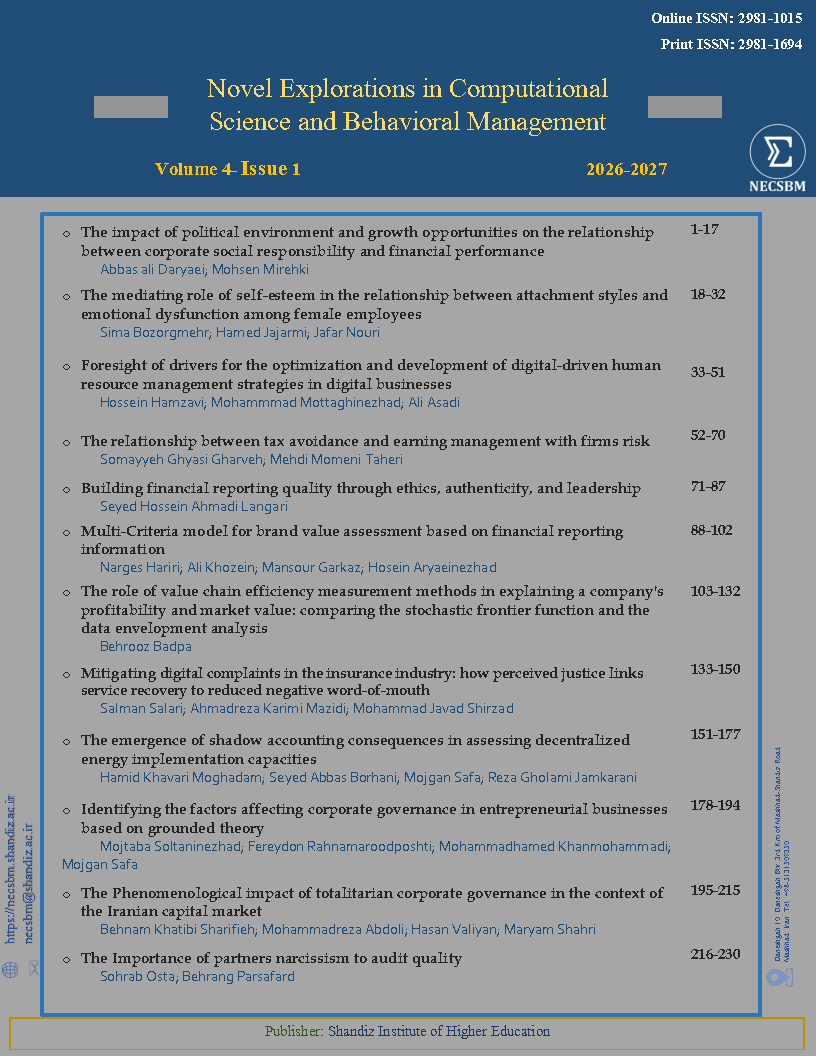
The Phenomenological impact of totalitarian corporate governance in the context of the iranian capital market

Document Type : Original Article

Authors
Department of Accounting, Sha.C., Islamic Azad University, Shahrood, Iran.
Abstract
This study aims to develop a model of totalitarian corporate governance within the context of the Iranian capital market. Adopting a paradigmatic phenomenological framework and an inductive-exploratory approach, this research conducted open coding on semi-structured interviews and researcher-developed scoring checklists to delineate the propositional-phenomenological foundations of totalitarian corporate governance. Subsequently, through a structured checklist featuring symmetric positive and negative scales, focus panel categorization was performed. Ultimately, by classifying the emergent categories across five core dimensions causal conditions, contextual factors, intervening conditions, strategies, and consequences the research paradigmatic model was formulated. The sample comprised 22 key actors actively involved in corporate governance standard-setting alongside certified public accountants with executive expertise. The empirical findings revealed 401 open codes, 65 contextual propositions, and 13 distinct categories associated with the emergence and characteristics of totalitarian corporate governance. The interpretation of the paradigmatic model indicates a hidden operational stream wherein totalitarian corporations exploit institutional oversight deficiencies to secure disproportionately high-profit returns. Consequently, the manifestation of totalitarian corporate governance is the product of intertwined endogenous and exogenous functions that foster the expansion of totalitarian firms—systematically prioritizing the preservation of founders’ and dominant power structures’ interests at the expense of minority shareholders.
Keywords
Subjects

Alvesson, M., & Kärreman, D. (2004). Interfaces of control: Technocratic and socio-ideological control in a global management consultancy firm. Organization Studies, 25(3), 423–444. https://doi.org/10.1177/0170840604040662
Antonelli, V., Bigoni, M., Funnell, W., Cafaro, E, M. & Gagliardo, E, D. (2024). Popular culture and totalitarianism: Accounting for propaganda in Italy under the Fascist regime (1934–1945), Critical Perspectives on Accounting, 96(2), 119-237. https://doi.org/10.1016/j.cpa.2022.102524
Arendt, H. (1962). Action and the ‘pursuit of happiness, in A. Dempf (ed.), Politische Ordnung und menschliche Existenz. Festgabe für Eric Vögelin zum 60. Geburtstag (München:Beck), 1-16.
Atkinson, A. C., Donev, A. N. &, Tobias, R. D. (2007). Optimum Experimental Design, with SAS. Clarendon, Oxford. https://doi.org/10.1093/acprof:oso/9780199296606.001.0001
Bagherzadeh Azar, F. , Mohseni Zonouzi, S. J. &, Mansourfar, G. (2020). The Nonlinear Relationship Between the Uncertainty of Government Economic Policies and Economic Growth of Iran with Emphasis on the Development of Financial Markets in a Novel Gas Model Framework. Applied Theories of Economics, 7(2), 103-128. [In Persian] https://doi.org/10.22034/ecoj.2020.11010
Beyer, A., Cohen, D., Lys, T., & Walther, B. (2010). The financial reporting environment: Review of the recent literature. Journal of Accounting and Economics, 1(4), 1-15. https://doi.org/10.1016/j.jacceco.2010.10.003
Cao, Y. (2025). Totalitarian Accounting &, the Trumpian Risks, MSI Journal of Economics and Business Management, 2(3): 13-16. https://mpra.ub.uni-muenchen.de/125456
Charoenrook, A. &, Lewis, C, M. (2009). Information, Selective Disclosure, and Analyst Behavior, Financial Management, 38(1), 39-57. https://doi.org/10.1111/j.1755-053X.2009.01027.x
Chen, S, C, K. &, Xiaoming, W. (2024). New wave of totalitarianism/authoritarianism in East Asia: an editorial introduction, Culture Studies, 38(1), 1-9. https://doi.org/10.1080/09502386.2023.2261947
Deb, S, S. & Deb, S. (2024). The rise and fall of Enron: A cautionary tale of corporate greed and betrayal, International Journal of Multidisciplinary Research and Growth Evaluation, 4(5), 94-100. https://doi.org/10.54660/.IJMRGE.2023.4.5.94-100
Eslami Mehr, A., Borhani, S. A., Safa, M. & Gholami Jamkarani, R. (2024). Consequences of Promoting the Corporate Governance Sectarian Essence in Adherence to Shareholders' Rights: The Application of Phenomenological and Ethnographic Process. Journal of Accounting Knowledge, 16(1), 131-156. [In Persian] https://doi.org/10.22103/jak.2024.23038.4019
Frankel, R, M. (2017). Selective Disclosure, Journal of Financial Reporting, 2(1), 46-78. https://doi.org/10.2308/jfir-51958
Funnell, W. (2016). Accounting and the pursuit of utopia: The historical role of accounting in constructing totalitarian regimes. Accounting, Auditing & Accountability Journal, 29(2), 254–279. https://doi.org/10.1108/AAAJ-03-2014-1647
Geis, M, E., Bosiacki, A. & Safferling, Ch. (2025). Dealing with Totalitarian Regimes and Human Rights: A Polish-German Dialogue - Interdisciplinary Studies in Human Rights, Interdisciplinary Studies in Human Rights, 1-198. https://doi.org/10.1007/978-3-031-55998-8
Gramsci, A. (1996). Modern Prince & Other Writings, in The Prison Notebooks (Quaderni del carcere), Translated by Louis Marks, Lawrence and Wishart, International Publishers Company. https://doi.org/10.7312/gram15502
Harste, G. & Laursen, K.B. (2022). Niklas Luhmann's anti-totalitarian observation of systems, Kybernetes, 51(5), 1710-1723. https://doi.org/10.1108/K-04-2021-0328
Healy, P. M., & Palepu, K. G. (2001). Information asymmetry, corporate disclosure, and the capital markets. Journal of Accounting and Economics, 2(1), 36-59. https://doi.org/10.1016/S0165-4101(01)00018-0
Isenmila, P, A. & Adewale, A, O. (2012). The Role of Capital Market In Emerging Economy," International Journal of Business and Social Research, MIR Center for Socio-Economic Research, 2(6), 61-71. https://thejournalofbusiness.org/index.php/site/article/view/134
Keane, Ch, R. (2001). Managerial Hegemony, Cultural Change, and the Transformation of Infant Care Advice in the United States in the Twentieth Century, International Journal of Health Services, 31(1), 98-119. https://doi.org/10.2190/9350-27KH-83CN-033A
Khodari, G., & Khoram, A. (2022). The decline of empathy in totalitarian systems from the perspective of Hannah Arendt. Contemporary Political Essays, 13(3), 53–75. [In Persian]. https://doi.org/10.30465/cps.2022.41259.3016
Majidi-Yazdi, M., Valian, H., Shari, M., & Abdoli, M. R. (2024). Shadow accounting action research for classifying corporate social value compliance in capital markets. Accounting and Social Benefits, 14(1), 237–270. [In Persian]. https://doi.org/10.22051/jaasci.2023.44653.1794
Neu, D. (2006). Accounting for public space. Accounting, Organizations and Society, 31(4/5), 391–414. https://doi.org/10.1016/j.aos.2005.09.002
Novak, J. (2010). Understanding and Judging History: Hannah Arendt and Philosophical Hermeneutics, Meta: Research in Hermeneutics. Phenomenology, and Practical Philosophy, No2. http://www.metajournal.org/articles_pdf/239-257-novak-meta2-tehno.pdf
Ogbor, J.O. (2001). Critical theory and the hegemony of corporate culture, Journal of Organizational Change Management, 14(6), 590-608. https://doi.org/10.1108/09534810110408015
Paić, Ž. (2023). The Return of Totalitarianism, Springer Nature Link, 2(1): 71-102.
Pathak, M., Chandani, A., Ubarhande, P. & Bagade, S. (2025). Unveiling corporate governance dynamics: a qualitative analysis of financial performance, Qualitative Research in Financial Markets, Vol. ahead-of-print No. ahead-of-print. https://doi.org/10.1108/QRFM-05-2024-0115
Paul, E. & Ochoa, E, P, T. (2020). Corporate Governance in the Organization for Economic Cooperation and Development (OECD) and Its Influence on the Code of Good Corporate Governance for Peruvian Corporations Journal of Applied Business and Economics, 2(1), 163-169. https://doi.org/10.1016/j.ribaf.2024.102489
Sabzaei, M. T. (2012). Civil society versus totalitarian regimes: A sociological analysis of Eastern European approaches to civil society. Iranian Journal of Sociology, 13(1–2), 109–129. [In Persian]. https://doi.org/10.33827/jsi/2012.33421.2019
Samuels, J, A. (2024). Understanding the Dynamics of Financial Markets: A Comprehensive Analysis, Journal of Enterprising Communities: People and Places in the Global Economy, 19(3), 1-19. https://doi.org/10.1108/JEC-10-2024-0201
Shafakhibri, N., Hirad, A., Abdoli, M. R., & Sotoudeh, R. (2025). Ontology of Ponzi nature in the emergence of opportunistic accounting practices: Presenting a paradigmatic phenomenological model. Experimental Studies in Financial Accounting, 22(88), 1–19. [In Persian]. https://doi.org/10.22054/qjma.2025.86793.2691
Taheri, M., & Amini, Y. (2021). The role of corporate governance and stakeholders’ rights in Islamic banking. Islamic Financial Research Journal, 10(19), 1–38. [In Persian]. https://doi.org/10.30497/ifr.2020.75400
Tan, Y.-L. & Mohamad Shafi, R. (2022). Capital market and economic growth in Malaysia: the role of ṣukūk and other sub-components, ISRA International Journal of Islamic Finance, 13(1), 102-117. https://doi.org/10.1108/IJIF-04-2019-0066
Trebing, H, M., Goldstene, P, N. (1990). Corporate Hegemony, Journal of Economic Issues, 24(4), 1147-1155. https://doi.org/10.1080/00213624.1990.11505109
Zamanianfar, L. , alidadi, H. , Heidari, D. & Altafi, A. (2024). The Motivational Contexts of the Governance Hegemony of Family Ownership: Reflecting on Caudillo's Governance Theory. Empirical Studies in Financial Accounting, 21(84), 279-316. [In Persian] https://doi.org/10.22054/qjma.2024.80909.2592
Zou, H, F. (2025). Why Totalitarian Regimes Fall: A Unified Model of Power, Conformity, Dissent, and Entropy, Central University of Finance and Economics, 2(1), 1-17. https://ideas.repec.org/p/cuf/wpaper/767.html
Zuberi, F. and Susewind, R. (2024). Totalitarian Law and Communal Ghettoisation: An Arendtian Perspective, Social & Legal Studies, 3(4), 1-23. https://doi.org/10.1177/09646639241266
Volume 4, Issue 1 - Serial Number 7
September 2026
Pages 195-215

  • Receive Date 09 November 1404
  • Revise Date 20 February 1405
  • Accept Date 21 February 1405