Novel Explorations in Computational Science and Behavioral Management

Novel Explorations in Computational Science and Behavioral Management

Number of Volumes 4
Number of Issues 7
Number of Articles 96
Number of Contributors 188
Article View 65264
PDF Download 31,623
View Per Article 679.83
PDF Download Per Article 329.41
Accepted Submissions 96
Acceptance Rate 29
Time to Accept (Days) 82
Time to Publish (After Acceptance) (Days) 3
Number of Indexing Databases 12
Number of Reviewers 199


Novel Explorations in Computational Science and Behavioral Management (NECSBM) is a scientific and semiannual journal that is open access and dedicated to the development of knowledge and research in the field of behavioral studies in finance and management. The objective of the journal is to publish scientific articles that reflect the achievements of researchers and to develop a platform for the exchange of ideas on a wide range of important topics related to the scope of the journal. We invite original research contributions in the fields of behavioral sciences applied to accounting, finance and management, with a particular emphasis on the integration of artificial intelligence (AI).

The NECSBM receives academic support from the Iran Management Accounting Association. Novel topics and methodology, the use of innovative research designs and advanced statistical techniques particularly artificial intelligence (AI) in applied and specialized research, are special priorities for publication. Further information about the journal is as follows:

  • Journal type: Research journal- MSRT grade "B"
  • Articles type: Research- Review
  • Publication license: 93644
  • Publication frequency: Semiannual (March-September)
  • Language: Persian-English
  • Open access: Yes
  • Article Processing Charge (APC): No
  • Country of Publication: Iran
  • Publisher: Shandiz Institute of Higher Education
  • Email: necsbmshandiz.ac.ir
  • Review type: Double-blined peer review
  • Time to 1st decision: One week
  • Publication Type: Dual-Format (Print & Electronic)
  • Licensed by: CC BY-NC 4.0
  • The journal adheres to the COPE ethical code of conduct.
  • The flowchart illustrating the peer-review and manuscript acceptance procedure is described in the 'Journal Information' section under the Peer Review Process menu.

All papers published in NECSBM are freely available as open access and can be copied, downloaded, printed, and distributed without charge or delay. Authors are not required to pay any article processing charges (APCs).


SamimNoor

NECSBM uses plagiarism softwares (SamimNoor, PLAGIARISMA, ithenticate) 


All articles published in the NECSBM are assigned a Digital Object Identifier (DOI).


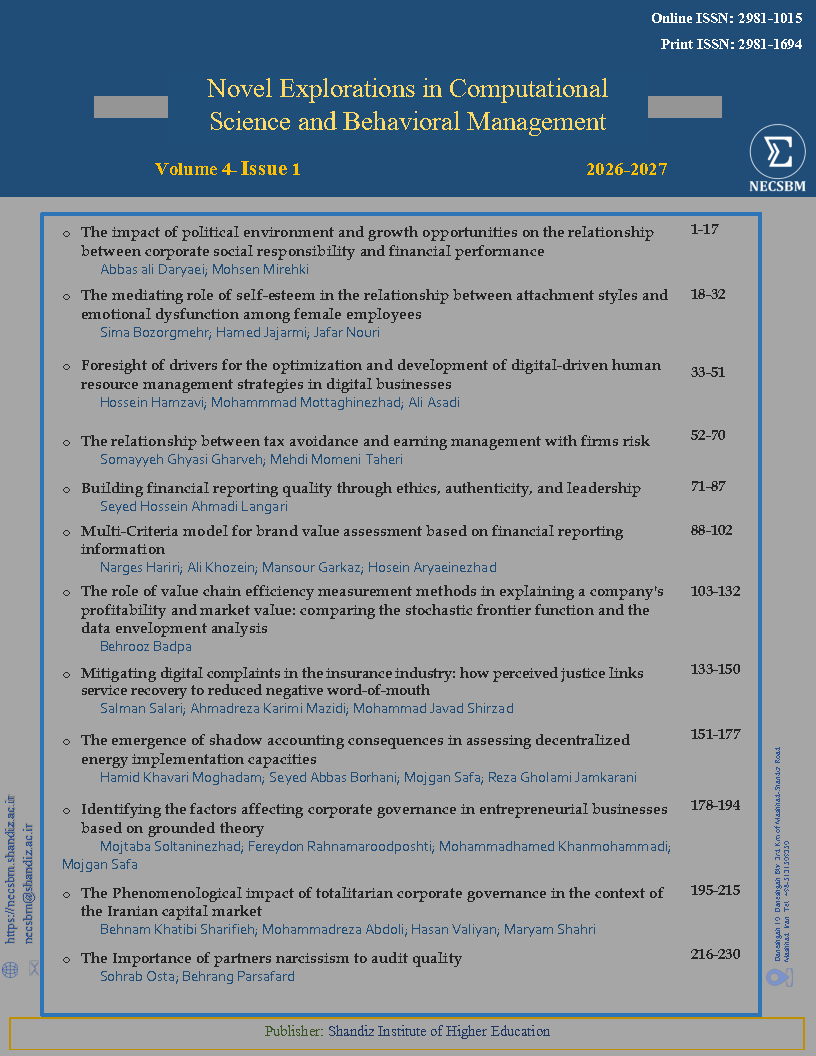
Current Issue: Volume 4, Issue 1 - Serial Number 7, September 2026, Pages 1-232 

Identifying the factors affecting corporate governance in entrepreneurial businesses based on grounded theory

Pages 178-194

10.22034/necsbm.2026.561517.1170

Mojtaba Soltaninezhad, Fereydon Rahnamaroodposhti, Mohammadhamed Khanmohammadi, Mojgan Safa

Keywords Cloud

  • perceived value
  • Earnings Management
  • cooperative companies
  • Customer Satisfaction
  • Social Media
  • Corporate Governance
  • financial performance
  • Attachment Styles
  • Mindfulness
  • Brand
  • Financial Literacy
  • Ethical Climate
  • mental health
  • Capital Market
  • Consumer Behavior
  • Organizational Justice
  • Political Connections
  • Fuzzy Delphi
  • Behavioral Finance
  • economic policy uncertainty
  • Economic Growth
  • Brand Image
  • Purpose in Life
  • Grounded theory
  • investment efficiency
  • Tourism Management
  • Self-esteem
  • Quality of Life
  • institutional ownership
  • Audit Quality
  • Job Satisfaction
  • Financial Technology
  • moral disengagement
  • Islamic Ethical
  • Employees
  • Value chain efficiency
  • dysfunctional schemas
  • Business Profitability
  • Professionalism
  • discretionary profit quality
  • Digital currency exchange employees
  • Female Employees
  • Risk Taking
  • innovative work behavior
  • Metaverse
  • Sustainable marketing
  • Transparency ranking
  • Razavi اospital of Mashhad
  • Market Orientation
  • Trust
  • physical index of the shrine
  • Behavioral persistence
  • internal control weakness
  • quantile regression
  • teamwork development
  • Board stability
  • teaching style
  • Financial Inclusion
  • Content Factors
  • Religious orientation
  • cash effective tax rate
  • Resilience Indicators
  • Service recovery performance, perceived justic,
  • motivation behavioral intentions of hospital visits
  • Operating Profit
  • Organizational Governance
  • supplier relationships
  • Environmental Factors
  • Social cohesion
  • automotive Industry
  • Quality of service
  • local institutions
  • Social Acceptance
  • Expertise of the Audit Committee
  • Radar Logic
  • Audit fees
  • EFQM
  • Moral Competence
  • Social participation
  • tax planning practices
  • problem-focused coping style
  • Earning Predictability
  • Happiness
  • artificial intelligence applications
  • Behavioral stimuli
  • Information technology
  • Loss aversion
  • Sales Growth
  • Financial and Non-Financial Consequences
  • Innovation Climate
  • Management Innovations
  • Tourist Attraction
  • corporate sustainability performance
  • Digital management accounting
  • righteous
  • Investor behavior
  • cash holdings
  • kindness
  • digital transformation
  • Sepehr KarAmadan Company
  • Corporate Risk
  • Capital Markets
  • Growth Opportunities
  • individual emotions
  • Industrial marketing
  • Certified Accountants
  • environmental forces
  • risk tolerance
  • banking industry
  • global factors
  • organizational trust
  • export performance
  • human resources
  • organizational citizenship behavior
  • management of Razavi\' s blessed places
  • going concern opinion
  • Human Development Index
  • sustainable business development
  • self-compassion
  • Family Firm
  • Dominance
  • Foreign direct investment
  • Managerial transitions
  • Academic performance
  • firm ownership
  • entrepreneurial businesses
  • Discretionary accruals
  • Human capital
  • Parental conflicts
  • social responsibility
  • Meaning of life
  • Internalized Shame
  • Gender diversity
  • Monetary Amounts of Audit Report Paragraphs
  • problem-solving skill
  • Signal Theory
  • digital-centric human resource management
  • Cognitive attitude of the market
  • self-criticism
  • Delphi-fuzzy
  • . marketing
  • intrapersonal intelligence
  • Job Burnout
  • Electronic banking services
  • Customer Relationship Management (CRM)
  • Servant leadership
  • Operating Cash Flow
  • Fin Tech
  • task learning
  • high-income provinces
  • internal audit arrangement
  • Innovation Capacity
  • Disclosure of company sustainability
  • customer feedback management
  • Stock Price Crash Risk
  • Attitudes toward AI
  • Future Studies
  • Personal Values
  • Household Financial Vulnerability
  • Type of Audit Report Paragraphs
  • Organizational Identity
  • Emotional Creativity
  • adolescents
  • Housewives
  • Urban Resilience
  • Organizational Excellence Model
  • Future Thinking
  • Electronic Commerce
  • Financial Reports
  • Social Capital
  • Mental image
  • Transformational Leadership
  • Corporate Financialization
  • Perceived corruption
  • structural equation modeling
  • auditing in metaverse
  • agency problem
  • Mental stimuli
  • joint stock cooperative companies
  • Characteristics of influencers
  • alexithymia
  • Ethical Accounting
  • Value
  • Emotional discipline
  • emotion-focused coping style
  • accounting in metaverse
  • product market competition
  • Educational-moral functions
  • Exchange rate
  • Organizational Culture
  • Institutional policies
  • auditor type
  • host society behavior
  • electronic customer relationship management
  • Stochastic Frontier Function
  • Investment Decisions
  • Earnings Quality
  • Mediator role
  • Learning capacity of managers
  • Brand engagement